Bagels
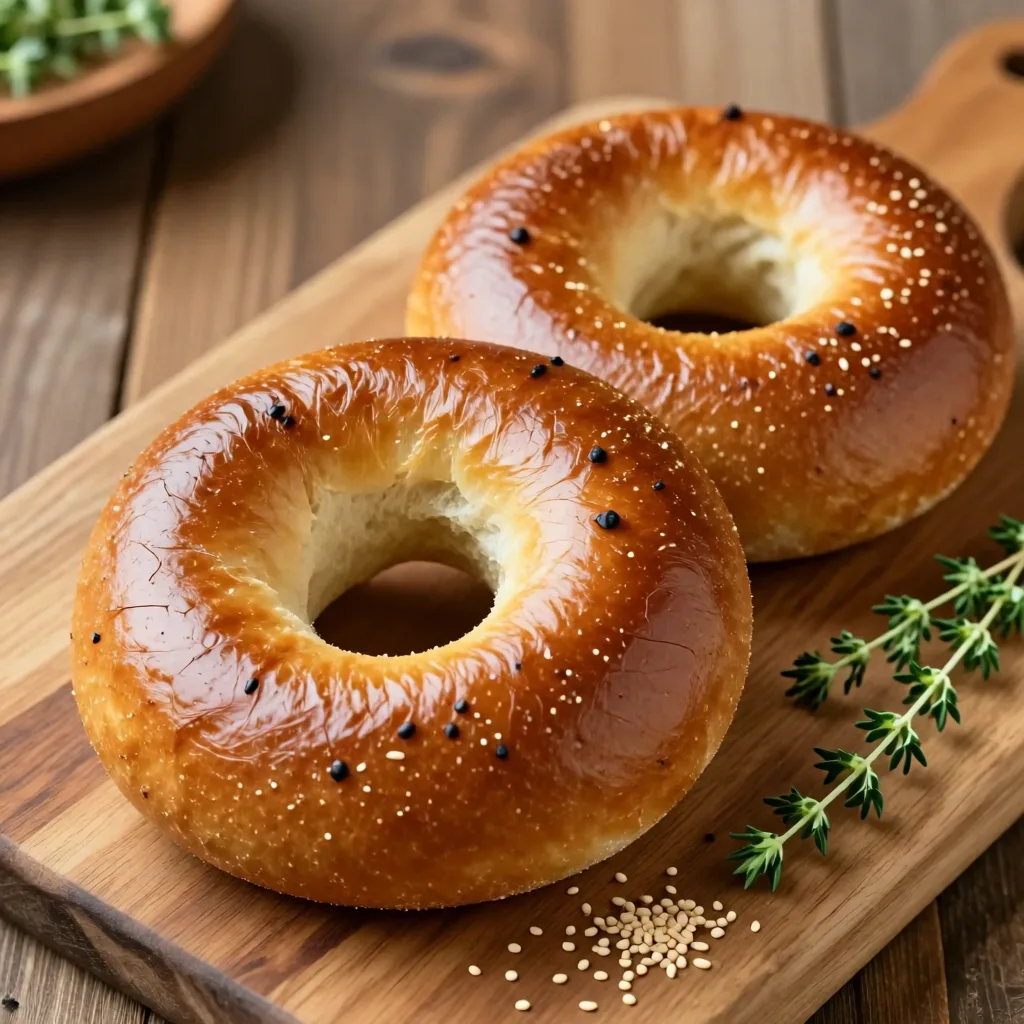
These bagels have a wonderfully chewy texture and taste even better as you keep eating. Be careful not to over-proof during the final rise, and avoid leaving them in the water bath too long.
Ingredients
French bread flour (France)
225 g
rye flour
25 g
granulated sugar
13 g
salt
5 g
shortening
5 g
fresh yeast (or 2 g instant dry yeast)
5 g
water
140 ml
fat or oil (for greasing the bowl)
to taste
Instructions
1
Mix the ingredients and begin kneading on the work surface
Place the French bread flour, rye flour, granulated sugar, salt, and non-fat milk powder in a mixing bowl. In a separate bowl, use a whisk to combine the water with the fresh yeast. Add the dry ingredients to the liquid. Stir in a circular motion with your fingers. Once the dough comes together into a single mass, transfer it to the kneading surface, using a bench scraper to remove any dough stuck to your hands. Hold the dough with both hands, stretching and tearing it over the kneading surface while continuing to knead until the dough has an even firmness throughout. Use a bench scraper to gather any loose dough from the edges back into the main mass. Fold the dough toward you from the opposite side, then use the palm of your hand to push the dough away from you, allowing the seam to gradually rotate from underneath to the top.
2
Knead the dough (about 15 minutes)
Rotate the dough 90° horizontally, fold it toward you from the opposite side, and use the palm of your hand to push it away. Continue this motion for 15 minutes. While kneading, make sure to scrape off any dough that sticks to your hands. After 15 minutes the surface of the dough should be very smooth. Pull off a small piece of dough and stretch it into a square to confirm that a thin, even gluten membrane has formed.
3
First fermentation (28-30°C, about 30 minutes)
Grease a bowl, place the dough inside, and let it ferment at 28-30°C for 30 minutes. Keep the dough humid so it does not dry out. Dust the kneading surface with flour and transfer the dough onto it. Use a bench knife to cut the dough into stick shapes, then divide the dough into 80 g pieces (5 pieces total). Combine the remaining dough with the divided pieces.
4
Shape the bagels
Press each divided dough piece flat with the palm of your hand. Use a rolling pin to roll the dough into a rectangle. Fold over 1/3 of the dough, then fold the remaining 1/3 over it, and use the heel of your hand to seal the seam. Fold the dough in half again and use the heel of your hand to press the seam closed. Round both ends of the dough while rolling the entire piece into a stick about 25 cm long. Taper one end of the stick slightly narrower, then flatten the other end. Bring the two ends together to form a ring, wrap the flattened end around the other end, and press the seam closed with your fingers.
5
Final proof (about 35°C, about 30 minutes)
Line a tray with a slightly thick canvas cloth, place the shaped dough on top, and proof at an ambient temperature of about 35°C for about 30 minutes.
6
Boil the dough (about 1 minute total, both sides)
While the dough is proofing, prepare some hot water in a fairly large pot and bring it to a light boil. Dip each dough piece in the gently boiling water for about 30 seconds per side, about 1 minute total for both sides. Once the dough has shed excess water, place them on a tray lined with baking parchment.
7
Bake (about 220°C, about 15 minutes)
Bake the bagels in an oven preheated to about 220°C for about 15 minutes.