
Caraquillo
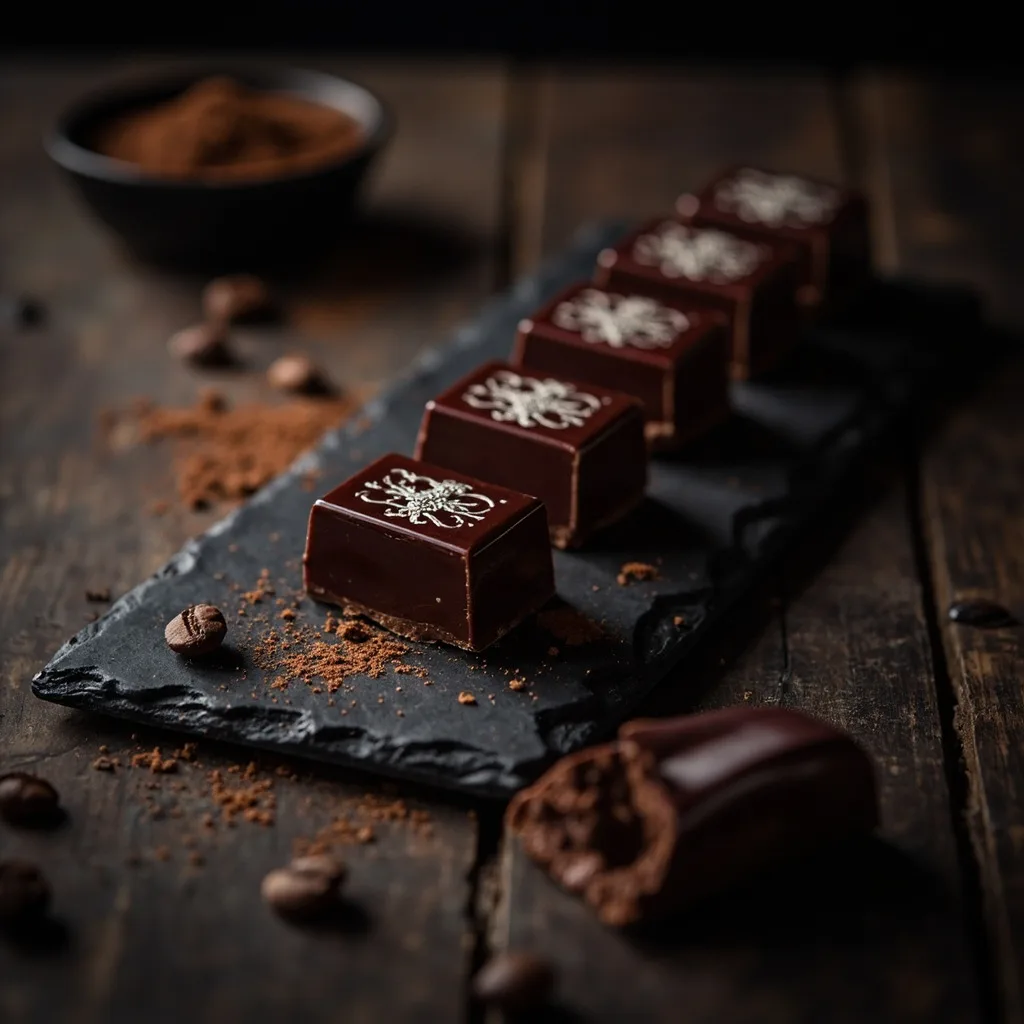
Caraquillo: coffee-anisette ganache filled chocolates, with a glazed surface decorated with textured silver embossed foil sheets.
Ingredients
UHT liquid cream
635 g
ground PH blend coffee
40 g
Caraque couverture chocolate
790 g
invert sugar
115 g
fresh butter
120 g
Ricard anise liqueur
38 g
extra bitter couverture chocolate (at the proper tempering point)
as needed
Pre-printed rhodoïd sheets 'silver touch' (pre-cut)
as needed
Instructions
1
Mechanical Method
Bring the cream, invert sugar, and coffee to a boil, let steep for about 10 minutes, then strain through a fine sieve. Place the chopped Caraque chocolate in the Stephan mixer bowl, apply vacuum (70 to 80 mbar), and draw in the boiled coffee infusion in three additions, emulsifying for one minute between each addition. When the mixture reaches 40 to 45°C, gradually open the valve to prevent air from rushing back, then remove the lid. Add the cold butter and Ricard anise liqueur, reapply vacuum to the Stephan mixer bowl, and stir for two minutes. When the ganache reaches 35 to 38°C, spread it out immediately.
2
Manual Method
Bring the cream, invert sugar, and coffee to a boil, let steep for about 10 minutes, then strain. Chop the chocolate and melt it at 45°C in a bain-marie or microwave in a plastic bowl. Pour the boiled mixture (about 90°C) over the melted chocolate, then begin stirring from the center outward gradually, expanding the strokes to the edges as the mixture emulsifies like mayonnaise (be careful not to stir too vigorously to avoid incorporating air). When the mixture reaches 40 to 45°C, add the butter in small pieces and the Ricard, continuing to stir in the same way until the butter is fully incorporated. When the ganache reaches 35 to 38°C, spread it out immediately.
3
Spreading
Prepare guides or frames 12 mm high. Pour the ganache to the full length, spread with a spatula, and smooth with a ruler. Crystallize at 16–18°C.
4
Pre-coating and Cutting
Once the body has set, score around the stainless-steel guides with a small knife; cut into 40 cm wide slabs sized to fit the cutting frame. Keep the body at this temperature throughout crystallization. Pre-coat one side of the body with a very thin layer of tempered chocolate; let it crystallize, then flip it onto baking paper and pre-coat the other side with a very thin layer of tempered chocolate. Before the chocolate crystallizes, cut into 30 x 15 mm rectangles. Store at 12°C.
5
Mechanical Coating
To achieve the best coating quality, working principles must be followed and humidity (below 60%) and laboratory temperature (24–27°C work area, 16°C crystallization area) must be strictly controlled. Temper the filling to 24°C about 1 hour before coating. Arrange the chocolates neatly and evenly spaced on the conveyor belt. Coat with tempered chocolate. Place a rhodoïd sheet centered on each chocolate; press with a tool of the same size. Crystallize on guitar paper at 16°C for 24 hours. Once crystallization is complete, quickly remove the rhodoïd sheets and package.
6
Manual Coating
Temper the filling to 24°C about 1 hour before coating. Heat the tempered chocolate to the tempering point. Using a dipping fork, fully dip each chocolate in the tempered chocolate, remove it, and tap against the edge of the bowl to remove excess. Place a rhodoïd sheet centered on each chocolate; press with a tool of the same size. Crystallize on guitar paper at 16°C for 24 hours. Once crystallization is complete, quickly remove the rhodoïd sheets and package.