
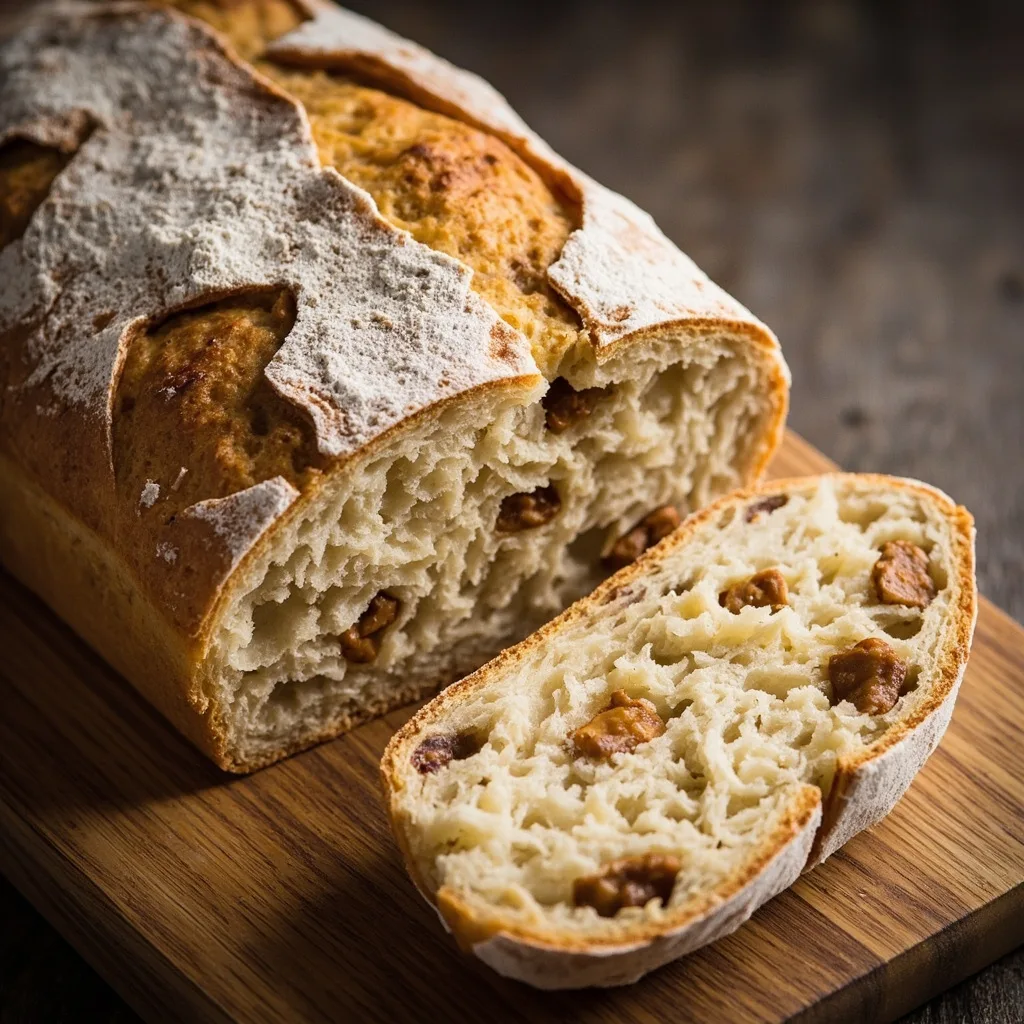
Walnut Soft European Bread
Walnut soft European bread is a soft, nutty baked good popular in Chinese bakeries, combining the chewy texture of European-style bread with the rich, earthy flavor of walnuts for a wholesome, satisfying treat.
Story
This beloved bakery staple is a localized adaptation of traditional European bread, tailored to local tastes with a soft, fluffy crumb and generous inclusions of toasted walnuts. Its subtle sweetness and satisfying chew make it a perfect go-to for a quick breakfast, afternoon snack, or pairing with a warm cup of coffee or tea.
Ingredients
high-gluten flour
175g
whole wheat flour
75g
cooked walnut kernels
50g
water
165g
salt
4.5g
sugar
20g
yeast powder
2.5g
butter
20g
Instructions
1
Step 1
Slightly crush pre-cooked walnut kernels and set aside (raw walnut kernels can be microwaved on high heat for 2 to 3 minutes; flip them halfway through).
2
Step 2
Soften the butter (in winter, place it in warm water; it is fine if it melts slightly, but try to let it return to room temperature before adding it to the dough later).
3
Step 3
Add all ingredients except butter and walnuts into the bread machine bucket (add liquid ingredients first, place salt and sugar diagonally opposite each other).
4
Step 4
Start the bread machine's kneading program, add the softened and temperature-adjusted butter after approximately 15 minutes (the temperature was too low in winter so I placed the butter in warm water, which caused it to partially melt before it returned to room temperature).
5
Step 5
Continue kneading the dough for roughly 30 minutes, until it can be stretched into a thin film that passes the windowpane test, add the walnuts and knead for about 5 more minutes, just until the walnuts are evenly incorporated into the dough.
6
Step 6
Take out the dough and transfer it to a bowl, gently shape it into a round ball.
7
Step 7
Cover with plastic wrap, place a bowl of warm water inside to proof the dough (the proofing environment should be around 27°C).
8
Step 8
Take out the dough once it has fermented to 1.5 to 2 times its original size (this recipe takes 100 minutes for proofing).
9
Step 9
Place it on a kneading mat.
10
Step 10
Divide evenly into two portions.
11
Step 11
Gently press to release air, then fold in thirds like folding a quilt.
12
Step 12
Tidy it slightly.
13
Step 13
Cover with plastic wrap and let it rest for 10 minutes.
14
Step 14
Take one portion of the dough and gently pat it into a rectangular dough sheet.
15
Step 15
Take the two corners at the narrow edge on the same side and fold them toward each other to form a triangle.
16
Step 16
Roll it toward the center.
17
Step 17
Seal it closed.
18
Step 18
Pinch to seal the opening.
19
Step 19
Flip it over and shape it into an olive shape. (Since it is difficult to describe with text and images, you can refer to the short video for the same recipe if you are unclear about the shaping technique.)
20
Step 20
Place a bowl of warm water nearby, and let it proof in a warm place (this batch took 40 minutes, with an ambient temperature of around 30°C).
21
Step 21
Remove it from the proofing area once it has doubled in size.
22
Step 22
Spray a small amount of water on the surface.
23
Step 23
Sift a small amount of high-gluten flour over the surface.
24
Step 24
Score the dough.
25
Step 25
Preheat the oven to 200°C with upper and lower heat turned on, then place the bread inside.
26
Step 26
Bake for approximately 20 minutes, then remove from the oven.
27
Step 27
Let cool, then use a brush to brush off the loose flour.
28
Step 28
Slice with a bread knife and serve.