Professional Braised Pork Offal Recipe & Production Process
Professional Braised Pork Offal: Ingredients and Preparation Method
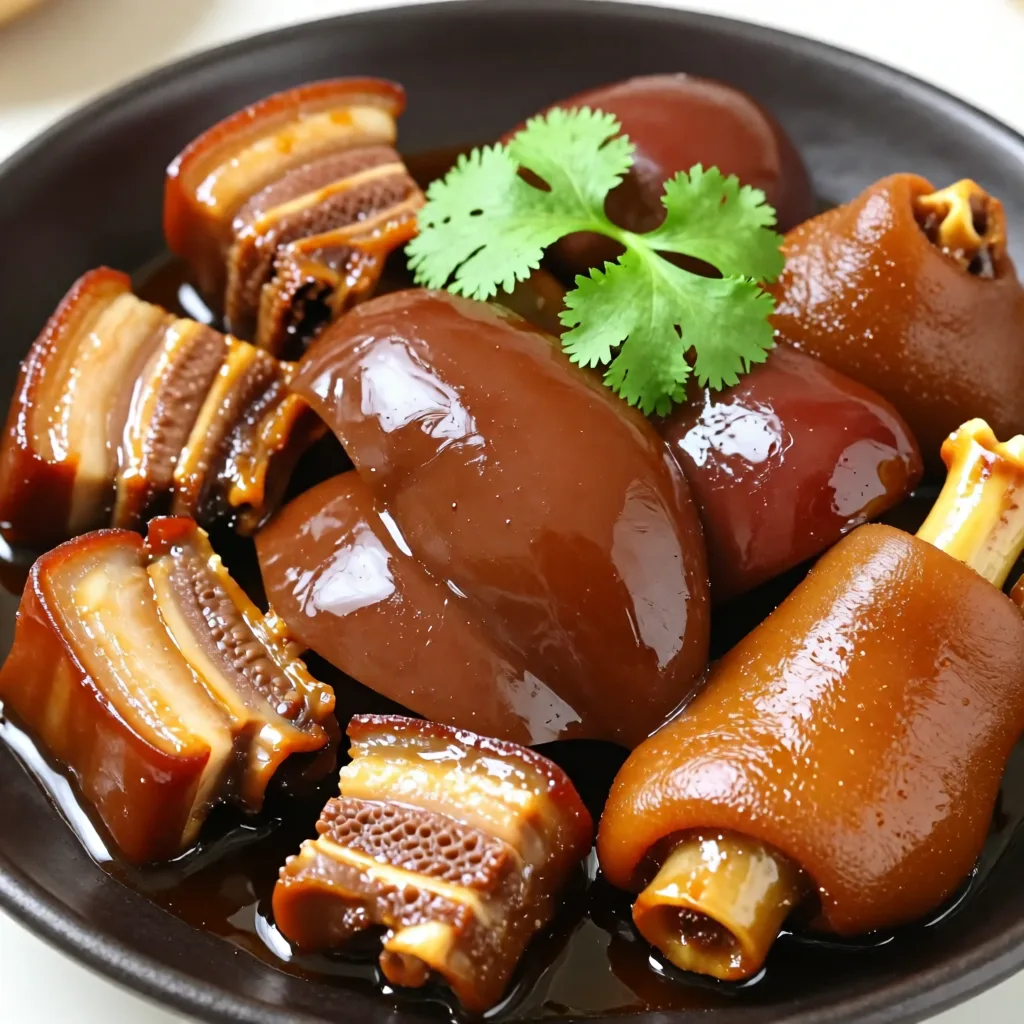
Ingredients
pork offal including pork head, tail, trotter, tongue, stomach, large intestine, heart, liver and other similar parts
100 kg
table salt
2500 g
fresh brine
4000 g
soy sauce
2000 g
white sugar
2000 g
caramel color
600 g
Chinese white liquor
2000 g
braising spice blend
1300 g
sand ginger
100 g
cloves
300 g
cassia fruit
50 g
fennel seeds
50 g
star anise
200 g
licorice root
200 g
nutmeg
100 g
cinnamon bark
200 g
dried tangerine peel
100 g
Instructions
1
Step 1
Ingredients
Pork offal (including pork head, tail, trotter, tongue, stomach, large intestine, heart, liver, and other parts) 100 kg.
Formulation (based on 100 kg of raw ingredients):
Table salt 2500 g (if no aged brine is available, use 4000 g of fresh brine), soy sauce 2000 g, white sugar 2000 g, caramel color 600 g, Chinese white liquor 2000 g, braising spice blend 1300 g.
Spice Blend Ratio:
Sand ginger 100 g, cloves 300 g, cassia fruit 50 g, fennel seeds 50 g, star anise 200 g, licorice root 200 g, nutmeg 100 g, cinnamon bark 200 g, dried tangerine peel 100 g.
Selection and Preliminary Processing of Raw Meat
Pork Head, Pork Tail, Pig Trotters
Remove hair and blood stains. First scald the hair in hot water at 75–80°C, then scrape off the hair. Use tweezers to pluck any remaining hair 1–2 times, and use an alcohol blowtorch to burn off remaining fine hairs, then trim clean with a knife. Split the pork head in half and remove the bone; cut the trotters into two-face three-knife sections from the trotter fork, then cut each half into two-face sections; do not cut the tail. Place in boiling water and cook for minutes, then remove and soak in clean water to wash.
Pork Tongue
Cut off from the root of the tongue, wash away blood stains, soak in 70–80°C warm water until the outer skin of the tongue can be peeled off with a fingernail. Remove, scrape off the white tongue coating with a knife, wash clean, then cut a small slit at the lower edge of the tongue root to allow seasoning to penetrate during cooking. Drain water and set aside for braising.
Pork Stomach
Turn the stomach inside out and wash clean, sprinkle with table salt or alum and rub to clean. After washing, soak in 80–90°C warm water for 15 minutes until the stomach turns firm and the inner white membrane can be scraped off with a knife. Remove and soak in cold water for 10 minutes, scrape and wash until there is no odor and the surface is not slippery. Drain water, cut into two large curved pieces from the bottom of the stomach, remove fat and tendons, and drain excess water.
Pork Large Intestine
Cut the large intestine into 40 cm long segments, turn the intestine inside out, then rub the intestinal wall with salt or alum to remove all dirt. Rinse with water, soak in boiling water for 15 minutes, then remove and soak in cold water to cool, then drain water.
Pork Heart
Cut the heart open, wash away blood stains, cut several leaf-shaped slits on the outer surface of the heart, and flatten it into a butterfly shape. Wash clean, soak in boiling water for minutes, remove, rinse with clean water, and drain water, set aside for braising.
Pork Liver
Cut the liver into three lobes, cut several branch-shaped slits on the surface of the large lobe, and wash away congealed blood with cold water. The other two smaller lobes can be cut crosswise into chunks or slices. Wash the liver clean, boil in water for 10 minutes until the liver surface is firm and the interior is bright orange. Remove and soak in cold water, rinse away blood stains from the slits.
Pork Kidney
Processing method is the same as pork liver. Note that the ureter and fat tendons must be completely removed, otherwise there will be a urine odor.
Sand Liver (Spleen)
Processing method is the same as pork liver.
Pork Hyoid Bone (Trachea)
This is a soft cartilage. Cut open one side of the trachea, wash away dirt, chop several times with a knife but do not cut it completely. Soak in 80–90°C warm water for 5 minutes, then wash clean.
Braising Method
2
Step 2
First put all the braising spice blend into a cloth bag (can be used 3–4 times consecutively), then add it to the pot together with soy sauce, scallions, ginger, soy sauce, white sugar, Chinese white liquor, table salt and other seasonings. Add the pork offal, then pour in clean water to submerge the raw ingredients. If aged brine is used instead of clean water, only 1250 g of table salt is needed.
3
Step 3
Add different varieties of offal to the brine pot in batches. Bring to a boil over high heat, then reduce to low heat to keep the brine at a gentle simmer. Add pig trotters first, cook for 30 minutes, then add pork head, cook for another 20 minutes, then add pork tongue and tail, cook for 40 minutes, then add pork heart, stomach, liver, kidney, large intestine, spleen, hyoid bone and other offal. Cook until the liver is fully cooked, the pork head meat can be pierced easily with chopsticks, the trotter bones protrude and the meat falls off the bone easily. Add MSG 15 minutes before removing from the pot, then the dish is ready to serve.
4
Step 4
After removing from the pot, place the offal flat on a cooked meat board according to variety, do not stack them. Immediately coat the offal with sesame oil after removing from the pot to give it a shiny appearance.
5
Step 5
Preparation of Sauce and Brine
The preparation of sauce and brine used in braised meat product processing is a key link affecting product quality. It requires the use of scientific formulations and high-quality ingredients to form the unique flavor and color of the product. Aged brine is very important when producing braised and marinated products; the longer the aged brine is used, the better the flavor of the final product. When producing braised products for the first time without aged brine, the ingredients need to be adjusted accordingly. After repeated use, aged brine will accumulate a large amount of sediment, which affects product consistency, so it must be filtered regularly to keep the aged brine clean. In industrial production, filtration or purification machinery can be used to complete the purification process. In addition, scum should be skimmed off cleanly each time before use, and the brine should be cleaned and boiled after use. Aged brine is usually used every day; aged brine that is not used for a long time should be frozen stored or boiled regularly to prevent spoilage.
6
Step 6
Aged Brine Processing and Storage
Aged brine is an important raw material for braised meat product processing, and good aged brine is an important condition for giving braised meat products their unique flavor. Aged brine contains a large amount of degradation products of protein and fat, and has accumulated rich flavor substances, which are important reasons for the unique flavor of braised meat products. However, during storage, these substances are easily utilized by microorganisms, causing the aged brine to spoil; aged brine that has been used repeatedly contains a large amount of residue and meat scraps, which also easily causes spoilage and flavor deterioration. When braising meat with aged brine containing impurities, the impurities will adhere to the surface of the meat, affecting product quality and consistency. Therefore, aged brine must be boiled before use; if it is not used for a long time, it must be boiled regularly and stored at low temperatures. Generally, aged brine that needs to be stored is filtered through a 50-mesh screen, scum and remaining residue are skimmed off, and then it is stored. Store at 0–4°C for later use. In industrial production, to maintain product consistency, mechanical filtration and other measures are usually used to uniformly filter aged brine, ensuring that all raw materials use aged brine that meets unified standards.
7
Step 7
Brine Preparation for Braised Meat Product Production
Brine preparation is a key link in the production of braised meat products. Brine is made by boiling aged brine with water and seasonings. The quality of brine is affected by factors such as the ratio of aged brine to water, the amount of table salt and seasonings, cooking method, and amount of water evaporated during cooking. In particular, the ratio of aged brine to water and the amount of water evaporated during cooking directly affect the concentration and salinity of the brine, which has a great impact on product quality, and must be strictly controlled and adjusted. If too much water evaporates during brine preparation for braised meat products, an appropriate amount of water can be added, and an appropriate amount of sliced ginger, food coloring, and other spices can be added, while taking into account the amount of aged brine used and adjusting the amount of salt added accordingly.
8
Step 8
Heat Control Technology in Braised Meat Product Processing
Heat control is an important link in the processing of braised meat products. Cooking over high heat causes the outer muscle to contract rapidly and strongly, making it difficult for seasonings to gradually penetrate the interior of the product, resulting in dry, hard, and tasteless meat with uneven saltiness inside and out, and light broth without meat flavor; cooking over low heat allows easy exchange of substances and energy inside and outside the muscle, resulting in tender, flavorful meat inside and out, with cloudy, thick, and aromatic broth, but it often requires longer cooking time, and the product is difficult to shape, with low yield. Therefore, heat control should be determined based on the variety and size of the product, and adjusted at any time as needed.
Heat control includes the control of heat intensity and heating time. Except for a few varieties, the general heating method for all products is high heat first, then low heat. Usually, the high-heat cooking time is relatively short, and the low-heat cooking time is relatively long. The purpose of high heat is to make the outer muscle contract appropriately to maintain the shape of the product, avoiding deformation or inability to remove from the pot after long periods of low-heat cooking; low-heat cooking is to allow seasonings to gradually penetrate the interior of the product, achieve uniform saltiness inside and out, and make the meat tender and flavorful. Heating time and method vary by product variety. Products with large volume and large pieces generally have longer heating times. On the contrary, the time can be shorter, but the premise is that the product must be fully cooked.
9
Step 9
Selection of Soy Sauce in Braised Meat Product Processing
Dark soy sauce is mostly used in braised meat products for coloring. Both light soy sauce and dark soy sauce are brewed and fermented soy sauce products. Light soy sauce has a lighter color, lighter soy flavor, heavier saltiness, and stronger umami, and is mostly used for seasoning; dark soy sauce has a darker color, is brownish, has a rich soy flavor, and lower umami, so there are products like mushroom-infused dark soy sauce that add straw mushrooms to enhance umami, which is generally used to color food, such as for braised dishes.
10
Step 10
Control of Sticking to Pot or Floating to the Surface During Braising
During the braising process of braised meat products, due to the boiling of the brine, some products will float to the surface and not be fully submerged in the brine, resulting in under-seasoned or undercooked meat. Therefore, at the beginning of cooking, stainless steel mesh or racks are usually used to press down the products, with heavy objects placed on top to keep them below the water surface, so that all products can be fully seasoned and product quality consistency is ensured. In addition, products that stay in contact with the pot for a long time during braising may stick to the pot, so racks or stainless steel mesh are sometimes placed under the meat to separate it from the pot, avoiding sticking.
11
Step 11
Brine Clarification in Braised Meat Product Production
In addition to most of the water, the brine also contains a variety of spice extracts, aromatic substances, and most of the pigments. These substances undergo more complex physical and chemical changes in a hot environment, forming a unique braised flavor. However, at the same time, these substances will also cause the brine to become cloudy, affecting the processing quality of the product. Clarifiers and adsorbents specially used for food processing can remove some impurities and pigments from the brine, but will weaken the flavor of the brine to a certain extent. In the production process, cloudiness can be controlled by adjusting heat intensity and ingredients, such as using low heat and adding angelica root to the spice mix to reduce cloudiness. Filtering the brine immediately after use can keep it clear.
12
Step 12
Caramel Color Preparation and Temperature Control
Caramel color is frequently used in the production of braised meat products, and the quality of caramel color preparation has a great impact on the appearance of the product. Caramel color is formed by caramelizing sugar solution under appropriate temperature conditions, and the key is temperature control. If the temperature is too low, caramelization reaction will not occur or will be insufficient, resulting in light-colored caramel; if the temperature is too high, the caramel will carbonize, resulting in dark, blackish caramel with a bitter taste. Therefore, neither too high nor too low temperature can produce good caramel color. When the temperature is insufficient: add a small amount of cooking oil to the pot first. The oil heats up to a higher temperature, which can ensure the caramelization of the sugar solution and avoid sticking to the pot. During the preparation process, strictly control high temperature to avoid bitter caramel caused by excessive heat.